

I find myself frequently questions like “What is God trying to teach me?” or “What does God want me know?”
These were the questions I readily asked when I stumbled across Marshall Rosenberg’s teachings on nonviolent communication.
Rosenberg was a clinical psychologist who developed the tenets for his theory of nonviolent expression in the 1960s and 1970s.
I got reeled in by the words compassion and empathy as these attributes are necessary in my work focused on helping the chronically homeless.
Like other members of our team, I often battle compassion fatigue and sometimes unconsciously checkout when it comes to repeatedly demonstrating any empathy to help others navigate their suffering.
Compassion fatigue is the cost of continually caring for others or for their emotional pain, resulting from our desire to help relieve the suffering of others. It is also known as vicarious or secondary trauma, referencing the way that other people’s trauma can become our own.

Nonviolent communication strikes a chord with me due to my upbringing. Both my parents, particularly my Mom, believed in nonviolence. My late father frequently wore a shirt that said “I am a lover, not a fighter.” Throughout my life, my Mom has always encouraged me to pursue peace and to try to be a peacemaker. Growing up, she would always encourage me to turn the other cheek. Admittedly, this is not something I naturally tended to do.
Living peacefully remains a pursuit that admittedly has escaped me at various times over the course of my life. However, it is still something I’ve tried to pursue.
Back when I worked as a corporate chaplain, I remember a military veteran,who I was counseling at the time, saying to me, “I am violent by nature, peaceful by choice.”
At work, someone recently placed a notecard on my desk about peace. It high lifted a verse from Isaiah.
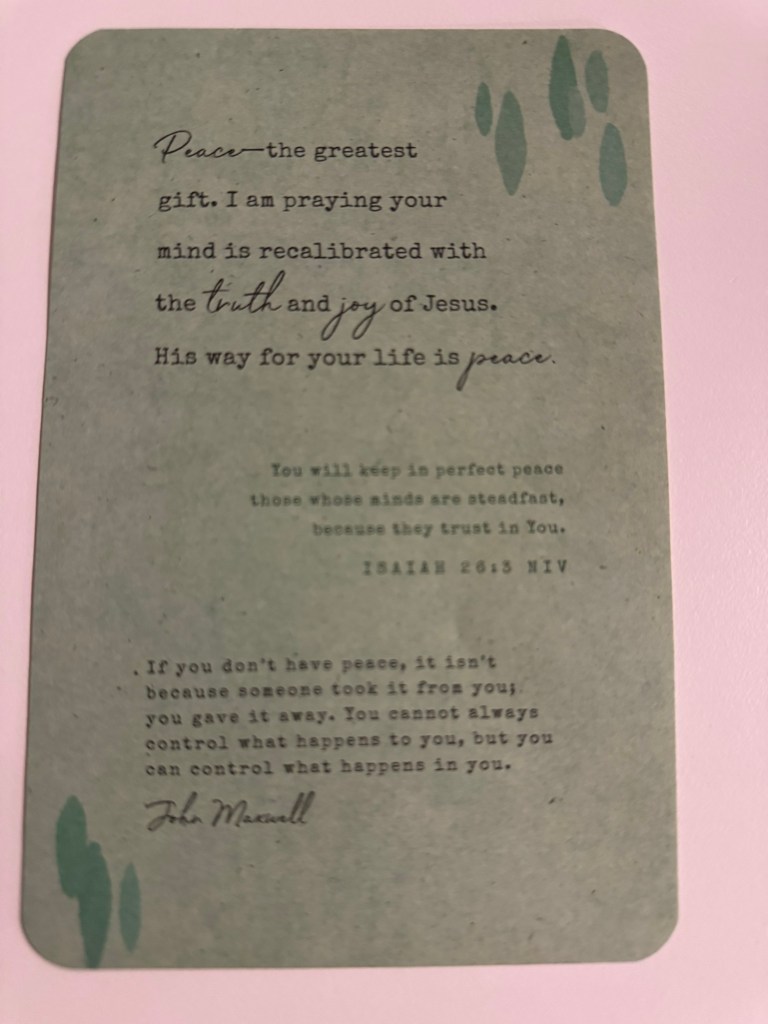
You will keep in perfect peace those whose minds are steadfast, because they trust in you.
Isaiah 26:3 (NIV)
The term “perfect peace” in Hebrew is expressed as “shalom shalom,” which signifies a peace that is complete and whole. It is a peace encompassing every part of one’s life.
This verse serves as a comforting reminder that our peace is not dependent on our surroundings or our own strength, but on our trust in God’s unchanging character and His sovereignty over our lives.
Isaiah 26:3 encourages believers to remain faithful and trust in God, assuring them of His peace amidst the storms of life.
I am unsure why someone chose to place this particular placard on my desk. It certainly has given me ample food for thought. Do they view me as someone struggling to find peace?
The 4 primary tenets of nonviolent communication are:
- Observation: Observing without judgment or evaluation, focusing on concrete actions or behaviors that are affecting us.
- Feelings: Identifying and expressing feelings triggered by observations, recognizing and acknowledging emotions without blaming others.
- Needs: Understanding and articulating the underlying needs or values behind our feelings, recognizing that all individuals have universal human needs.
- Requests: Making clear, actionable requests that are specific, doable, and aimed at meeting needs, rather than demands or commands.
According to Marshall Rosenberg, these principles help guide individuals to communicate more empathetically, as a result fostering greater understanding, connection, and cooperation in identifying ways to resolve conflicts.
At its core, the essence of nonviolent communication aligns extremely well with the teachings and examples of Jesus Christ as presented in the Bible. Nonviolent communication emphasizes empathy, compassion, understanding, and mutual respect—all qualities that Jesus both lived by and taught His disciples and followers.
After meditating on the subject of nonviolent communication, I have determined that “violent” communication is exhibited by our listening to reply. For example, when someone approaches the front counter, my internal radar may go up and I am ready to block, tackle, and defend our ground from anyone seeking to manipulate or intimidate us. This is particularly true if the person is a known previous offender. After quickly forming a judgement, I ready my response before they ever utter a word. Nonviolent communication is the opposite of that and seems to require stepping into each conversation anew, free from preconceived notions, and in a complete state of grace, ready to listen.
Do you consider yourself to be skilled at communicating nonviolently?
I hope you’ve been blessed by today’s post.
In March, I plan to unpack what it means to be steadfast. We will unpack the word steadfastness by exploring the book of James, Psalm 107, and other biblical writings teaching us more about this valuable trait.
Do you consider yourself steadfast?
As always, I look forward to reading your comments!
Abundant blessings,
Tell someone about Jesus today!
Rainer Bantau —The Devotional Guy™


 The Devotional Guy™
I am glad you found it helpful and hopefully useful. Praying for your friends and their daughter. Thanks for reading and sharing your response.
LikeLiked by 1 person
God’s light brought me to this testament. Your discussion of the contrast of our actions of empathy running into compassion fatigue really hits home. A family is in my daily prayers as their acts of love for a daughter keep running into the enemy’s wall of darkness. These parents find themselves underwater. Blessings to you Rainer for sharing this.
LikeLiked by 1 person
Thanks for reading and sharing your thoughts, Andy!
LikeLiked by 1 person
so hard to not end up being judgmental, when repeated judgements need to be made. more so, when there is a history
do i consider myself steadfast? i don’t know. i do see myself as someone who is not easily led and is able to hold my ground no matter the cost on all sorts of issues….
Andy B
LikeLiked by 1 person