
In my weekly Monday night drawing class, we’ve been spending a lot of time exploring perspective. This week, our focus turned to the work of French painter and sculptor Fernand Léger and his distinctive approach known as Tubism, a unique offshoot of Cubism. Both movements rely heavily on geometric forms to interpret reality. After all, there are no actual lines in nature; how we perceive and represent the world depends entirely on our perspective and perception.
Seeing God’s Design in Art
Every great work of art rests upon an unseen structure. Beneath Renaissance masterpieces, cathedral windows, and even the simplest sketches lies a foundation of geometric design. Lines, angles, and curves converge to create balance and harmony. Geometry is the silent architecture of beauty. It is the divine language through which God shaped creation with order and purpose.
Divine Geometry in Scripture and Creation
Scripture tells us, “The heavens declare the glory of God; the skies proclaim the work of His hands” (Psalm 19:1).
The entire universe pulses with mathematical precision and artistic grace. From the orbits of planets to the spiral of a seashell, every detail reflects the mind of a Creator who delights in both beauty and order.
As artists, we participate in that divine rhythm. When we compose, measure, and balance, we echo the moment when “the earth was formless and void, and the Spirit of God hovered over the waters” (Genesis 1:2). Through geometry, form emerges from chaos, just as creation was shaped by God’s voice.
© 2025 Rainer Bantau
All Rights Reserved
Geometry as a Spiritual Language
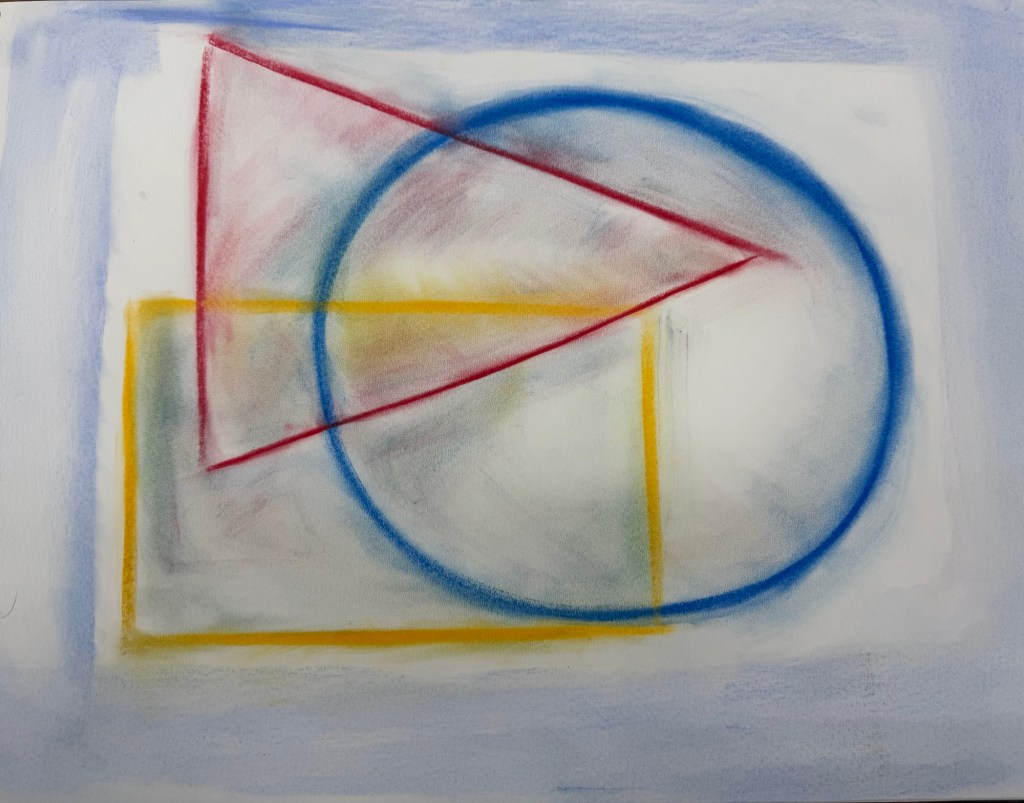
For centuries, artists have used geometric forms to symbolize eternal truths.
- Circles represent unity and eternity.
- Triangles point to balance and the Trinity.
- Squares suggest stability and foundation.
Even in modern art, where shapes and color often replace literal imagery, the pursuit remains the same: to find order in a disordered world and show divine harmony in human expression.
Artists like Fernand Léger hoped to translate spiritual reality into visible form, using geometry as their language of faith and structure.
Faith, Form, and Freedom
For believers, geometry becomes more than math; it becomes metaphor by reminding us that God’s beauty isn’t random. It’s relational. His creation blends freedom and form, grace and truth. When we create, we imitate the Creator though bringing order, rhythm, and meaning into our own spheres of life.
Whether painting, writing, or building, we are shaping our corner of chaos into something purposeful. Geometry teaches us that structure doesn’t limit creativity. It reveals it. Faith and form coexist, just as God’s love holds both mystery and design.

A Closing Reflection
Next time you sketch a line, frame a photograph, or balance a composition, remember that the same God who arranged the stars also orders your steps. He delights in your art, your order, and your openness to the creative flow of His Spirit.
Art and geometry remind us of one powerful truth:
God’s creation and our creativity are both expressions of divine design.

Until my next post…
Be salty, stay lit.
Rainer Bantau —The Devotional Guy™
You can now find my articles in The Christian Grandfather Magazine.
Please hit me up if you have questions or drop a comment below. And please subscribe to my blog!

#bgbg2#BibleGateway
The Stigma Stops Here.🛑
#mentalhealthmatters
© 2025 Rainer Bantau | The Devotional Guy™ | All Rights Reserved

 The Devotional Guy™
Yes, it does. I’m glad that you took time to drop your thoughts on my post. Blessings.
LikeLike
To bad I never learned this years ago; it helps to give Math a new perspective.
LikeLiked by 2 people