

In recent months, while settling into this season of healing and recovery, I’ve turned my attention to blogging. I’ve wondered what it would look like to be more intentional about my blogging and if I could earn a living from it. Naturally, this involves research and reading, in addition to seeking God’s will and guidance through prayerful conversation.
I’ve found that there’s no shortage of noise online. Everywhere you turn, someone is promising five secrets, ten hacks, or the one thing you’re missing—all wrapped in shiny titles engineered to snatch a scroll-stopping second of your attention. It’s like we are living in a constant infomercial. It’s a world built on algorithms and adrenaline. Somewhere in that digital maze, a deeper question keeps surfacing for those of us who write from a place of faith:
How can we blog for God’s glory in a culture shaped by clickbait?
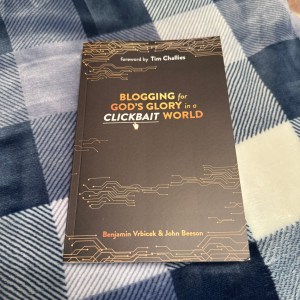
My journey led me to discover Blogging for God’s Glory in a Clickbait World, a wonderful book written for Christian bloggers, like me (and you), by pastors and fellow bloggers, Benjamin Vrbicek and John Beeson.

Honestly, I wasn’t sure what to expect. Would this book turn out to be another “Christian hustle” packed with a sea of platitudes and plethora of marketing tactics baptized in church-sounding language? Would it actually speak to the inner tension I feel as a writer who wants to be faithful and effective?
To my happy surprise, it did the latter.
Our Audience is First and Foremost God
Yep, Christian bloggers: we are writing for God. In their book, the authors push back, gently but firmly, against the temptation to measure our worth by analytics. It’s a needed reminder that numbers don’t tell the whole story. Lives do. Faithfulness does. Obedience does. That’s how we should measure the success of our blogging.
This part certainly hits home for anyone who has stared at a quiet dashboard and wondered if their words still matter.
Cultivate Depth over Virality
Clickbait thrives on shock, urgency, and shallow emotion. You and I know this. In counterpart, the Gospel thrives on truth, grace, and transformation.
The writers dare you and I to slow down, reflect, pray, and craft words that serve rather than seduce. Isn’t that refreshing?
This resonated with me deeply as someone who writes devotionals and reflections shaped and influenced by real ministry: funerals, friendships, grief, and finding hope amid the hopelessness. Our stories, written where the rubber meets the road, don’t need gimmicks. They need honesty.
Find Practical Rhythms for Writing with Integrity
Not hustle.
Not pressure.
Rhythms.
The kind of rhythms that grow out of spiritual practices like prayer, seeking discernment, attentiveness to people on the margins, and finding the courage to speak truth even when the culture prefers distorted noise.
It especially resonated with my own journey this past year of navigating loss, leadership shifts, and the slow rediscovery of my creative voice.
Where I Think This Book Stumbles Slightly
In my opinion, the book occasionally leans too heavily on idealism. It’s easy to say “ignore the algorithms” when your platform is already established. Newer bloggers—like many readers of The Devotional Guy™—would benefit from some more concrete help in balancing their integrity with hopes of discoverability (perhaps that’s something I can write about?).
Not every Christian writer wants to go viral. I know that may be hard to believe in a world of celebrity pastors and high profile Christian influencers.
However, we do want to be found by the people who need the words God entrusts to us.
I think a little more guidance on that intersection would’ve strengthened the book. But that’s just my opinion.
Faithfulness Over Flash
At its core, this book is a gentle nudge to step off the continuous treadmill of online performance and go back to the quiet place with God where authentic ministry begins.
For me, blogging has always been a blend of chaplaincy and being a Christian living out my faith in a 21st century world. My blog is a digital form of presence, offering encouragement, and spiritual care. It’s a way of saying:
“You’re not alone. God sees you. There is grace in the margins.”
All that to say: If you’re a Christian blogger, longtime or first time, I highly recommend this book. I’ve even shared it with a couple of my blogging friends, like Nathan, who blogs at Time for Providence and David who posts on David’s Daily Dose. While the book doesn’t offer a magic formula it does offer us a reminder:
Your writing doesn’t have to shout to matter. It just has to shine faithfully.
Discussion Questions
1. What tension do you feel between writing content that gets attention and writing content that honors God?
2. How do you personally navigate that balance?
Until my next post…
Be salty, stay lit.
Rainer Bantau —The Devotional Guy™
You can now find my articles in The Christian Grandfather Magazine.
Please hit me up if you have questions or drop a comment below. And please subscribe to my blog!


#bgbg2#BibleGateway
The Stigma Stops Here.🛑
#mentalhealthmatters
© 2025 Rainer Bantau | The Devotional Guy™ | All Rights Reserved


Thanks so much!
LikeLiked by 1 person
Those are both excellent quotes, Dana. Thanks for sharing. I’m glad your subscriber list is growing. Well-deserved. Blessings.
LikeLiked by 1 person
Much to consider, Rainer. It reminded me of two quotes by Oswald Chambers: “The proof that our relationship is right with God is that we do our best whether we feel inspired or not” and “Do what you can do and leave the rest of what you can’t do for God to handle.” Honestly, when I stopped fiddling with all the SEO nonsense I added more subscribers!
LikeLiked by 1 person
That’s an excellent idea and a beautiful plan, Robert.
LikeLiked by 1 person
Thanks brother. I know I’m a poor listener. I got a couple of journalling Bibles to get into writing by hand. I completed one and am slowly plodding my way through another. I have a third to complete to give them all to my daughter’s
LikeLiked by 1 person
I look forward to hearing what you think about it, Barb.
LikeLike
I’ve heard similar things about post literacy and I do think we are a much more visual culture than we once were, Robert. The 80/20 thing about reading is interesting to me. We are better at listening to reply than listening to hear. And we tend to talk first, listen later. Writing by hand certainly seems to be fading away. Anyways—that’s all material for future blogposts. You might be spot on about blogging in general being a niche thing. Further research needs to be done. Thanks for your insightful input, Robert. Blessings and continued happy blogging.
LikeLiked by 1 person
I will check it out.
LikeLiked by 1 person
I think there’ll always be a place for blogging, but I have heard rumblings of us becoming almost post literate, with younger generations tending to prefer vlogs to blogs. So maybe there’s a cultural/societal trend as well. I think I also heard that 80% of people prefer speaking and listening and only 20% prefer reading and writing, so I guess maybe even just generally, blogging is a bit niche
LikeLiked by 1 person
And you certainly do that well, Bridget. I’m glad the review was informative and I think you’d enjoy reading it. It’s got a lot to offer for those of us, like you, who’ve been blogging faithfully for Christ for good while. Blessings.
LikeLiked by 2 people
Thanks for this, Barb. I truly appreciate your transparency and insight. The book is a good read that I think you’d enjoy. Blessings.
LikeLiked by 1 person
I’m so glad you’ve cracked it open and are enjoying the read thus far, my friend. In later chapters, the authors discuss the never ending battle of fighting analytics and algorithms. I felt a bit “vindicated”’after reading their thoughts on the matter.
You write beautifully so keep doing what you’re doing for the Lord.
Blessings!
LikeLiked by 1 person
Great response, Robert. I don’t think you should compromise what you’re doing simply for the sake of pleasing others. I believe people appreciate authenticity and faithfulness, particularly those who willingly and wantingly read what we post. And you’re spot on—at the end of the day it’s all about writing for God’s glory. Thank you for sharing your experience and insights in response to my post. The book is a good read. Blessings.
LikeLiked by 1 person
I’ve actually heard of this book, but I haven’t read it. Thanks for the detailed review. I am not one that wants to go viral. I just want to bring encouragement to whoever might need it. I have a friend who would apologize to me for not reading every blogpost. And I would tell him, “It’s okay. God will lead you to any that you need to read.” Thanks again, Rainer. Great post.
LikeLiked by 1 person
I’m in a season of getting back to blogging for God.
I tried a couple of times to monetize my site but never had much success.
As far as clickbait…. don’t get me started on home aggravated it makes me
LikeLiked by 1 person
I’ve started my copy of the book you sent, and have already highlighted key points. Thank you for thinking of me, brother!
My blog stats are down from a high point about two years ago, and I’m not sure why. I think I’m still creating good content and writing for the audience I already have (a highlighted point in the book), but I’ve given up chasing the numbers.
Frankly, I believe Word Press has adjusted their algorithms to encourage pay-to-play elements like their boost program. Also, it looks like they now emphasize email subscriptions over folks who use their reader.
The bottom line is, I’m going to keep writing what God lays on my heart, while keeping my most faithful readers and commenters in mind.
LikeLiked by 2 people
Good questions. To be honest, I’m focused on writing for God’s glory, but maybe that makes me ‘superspiritual’ and not seeking to reach out as I ought to others. For me it’s about quality over quantity. If people aren’t interested in the glory of God and his Word then I’m not bothered if they’re not interested in my blog. That sounds a bit dismissive, I’m sure I should be more winsome and ‘all things to all people’s. Thanks for the post
LikeLiked by 1 person