

In previous posts, like this one, during my season of healing and recovery I’ve been working on decluttering. What started as something to do and occupy time has revealed itself to be something of much deeper and greater value.
Trauma, grief, and moral injury share a common feature: too much enters your life without your consent.
Death arrives uninvited.
Violence intrudes where care once lived.
Roles change without conversation.
Belonging erodes without ritual or repair.
After that, the nervous system becomes cautious. It scans constantly—not because I’m anxious, but because it has learned the cost of being unguarded. There is a price to pay.
After rupture, people often feel an unexpected urge to declutter.
Not organize.
Not improve.
Not optimize.
Just… remove.
At first, it feels shallow given the weight of what’s been lost. How can sorting through boxes matter when grief, trauma, and vocational collapse still ache beneath the surface?
But decluttering, in this season of rupture, is not about cleanliness or control.
It is about consent.
But he was pierced for our transgressions,
he was crushed for our iniquities;
the punishment that brought us peace was on him,
and by his wounds we are healed.Isaiah 53:5 NIV
When Too Much Has Entered Without Permission
Decluttering becomes one of the few places where you get to say, deliberately:
This stays.
This goes.
This no longer gets to claim space in my life.
That choice matters more than it looks like. It’s a big deal.
Imagine being held underwater too long. You wonder if you’ll ever come up for air. And just as you do, someone’s foot pushes you down. That’s what rupture looks like. You’ve carried too much for too long. You’re drowning.
What exactly is rupture, you ask? Great question.
Rupture is what happens when something essential that once held you (meaning, identity, belonging, trust) can no longer carry the weight placed on it.
Confidence is lost. Identity is questioned.
Rupture isn’t burnout, discouragement, transition, or doubt. I’m not simply exhausted from overuse. I wasn’t unmotivated by my calling. I hadn’t become overwhelmed by entering a new season of life. I wasn’t questioning my belief in God.
I no longer believed in myself. I no longer believed I was safe. I grew unsure about trusting those rowing in the boat beside me. My soul was deeply wounded.
The container holding my story broke. I couldn’t catch the pieces fast enough. They came crashing to the ground.
Decluttering and the Wounded Mind
After prolonged stress, the mind struggles with decision fatigue, prioritization, emotional regulation and memory.
Visual clutter quietly taxes those same systems.

Objects are no longer neutral. They carry unfinished intentions, reminders of former roles, expectations we no longer have energy to meet, and multiple versions of ourselves that no longer exist.
Decluttering reduces the ambient demand put on me by things that are not asking me to act right now but are still asking something of me simply by being present.
It’s not about order.
It’s about quiet.
There’s too much noise.
Lord, heal me, and I will truly be healed.
Save me, and I will truly be saved.
You are the one I praise.Jeremiah 17:14 NCV
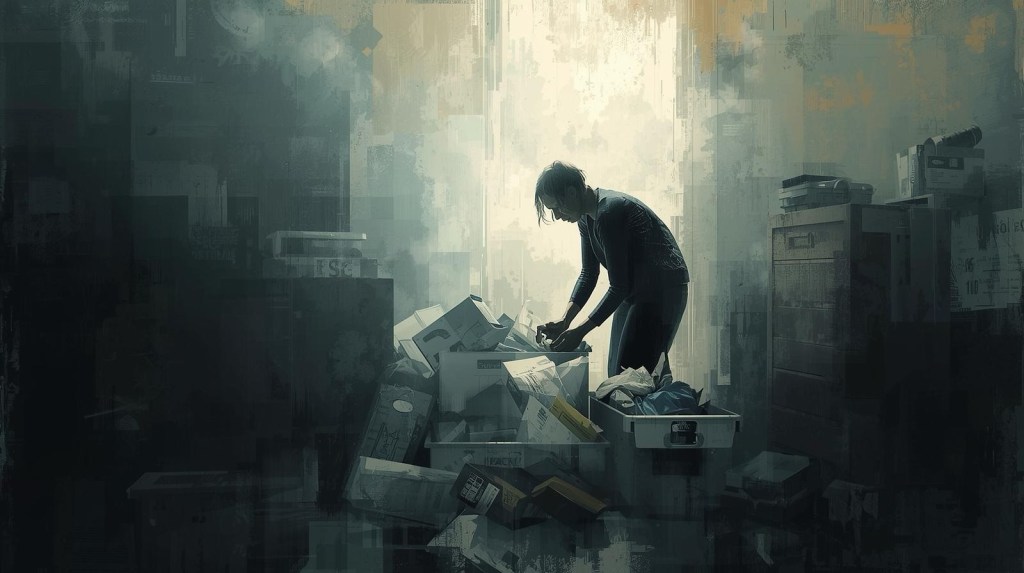
Decluttering as Grief Work
There are some things that are hard to release because holding on to them feels a lot like loyalty.
Books from a former calling or season of life, like my childhood or college.
Tools from work I no longer do.
Papers from a role that once defined me.
Letting go can feel like erasing memory or betraying a past self. Terri suggested I start simple. “Just do a box a day,” she said.
How do I unpack a mountain?, I wondered.
By decluttering, I am acknowledging change.
Each item released quietly whispers:
I no longer have to live as though the rupture didn’t happen.
I am choosing grief over avoidance.
Moral Injury and the Weight of “I Should”
Objects become silent accusers.
“I meant to use this.”
“I should get back to this.”
“One day, when I’m stronger…”
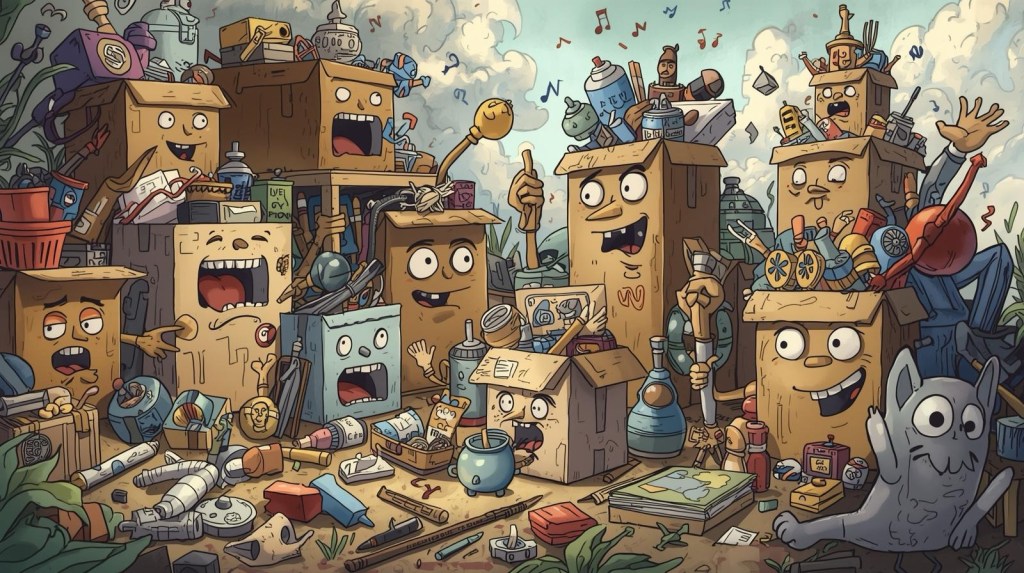
Decluttering is a means of forgiving myself for what could not be carried. Perhaps, I was never meant to carry it in the first place.
I am finite. I no longer had the capacity to help others. My cup was full yet my tank was well past empty. There was no room left in my soul. I had taken in too much for too long.
You cannot teach a man anything; you can only help him find it within himself.
Galileo Galilei
Spiritual Decluttering: Making Room Without Demands
Spiritually, decluttering does something subtle by slowly creating space.
Silence invites us and is no longer threatening. Prayer can be minimal without guilt of not saying more or not knowing what to say. We encounter God genuinely and authentically without the need for performance.
After rupture, the soul needs less words, not more. We learn to speak a new language.
Empty space becomes hospitable.
This Is Not About Control
Control suggests if everything is ordered, nothing will hurt me again.
Decluttering shows me I am allowed to live within my current capacity.

© 2024 Rainer Bantau All Rights Reserved
A Simple Way to Practice (Not a Project)
Don’t ask:
- Will I need this someday?
- Was this important once?
- Should I keep this just in case?
Ask only:
Does this support the life I am capable of living now?
Not the life you had.
Not the life you hope to have later.
The life you have today.
If not, release it.
That is ritual.
A Closing Image
After ICU, rooms are simplified. There are fewer machines, fewer alarms, and fewer tubes.
Similarly, decluttering is step-down care for the soul. You’re no longer in immediate danger but you’re not strong enough to carry a full load of responsibility or anything complicated. You’ve moved out of ICU and are now in your own room. Stable, but not ready to go home just yet.
Decluttering doesn’t heal rupture.
It makes healing possible.
Time is still the best critic, and patience the best teacher.
Frederic Chopin
© 2025 Rainer Bantau All Rights Reserved
As for me, a year after my great unraveling, I’m still in ICU. I’ve made progress. I’m noticeably better than I was. But I’m not ready for my own room yet. As Terri reminds me, “God’s got this.”
Christ carried our sins in his body on the cross so we would stop living for sin and start living for what is right. And you are healed because of his wounds.
1 Peter 2:24 NCV
Until my next post…
Be salty, stay lit.
Rainer Bantau —The Devotional Guy™
Please hit me up if you have questions or drop a comment below. And please subscribe to my blog!


#bgbg2#BibleGateway
© 2026 Rainer Bantau | The Devotional Guy™ | All Rights Reserved


I’m glad it resonated with you, Dana.
LikeLiked by 1 person
I’m glad if my words help in any way. Worship is a great salve for the soul, as music in general. Perhaps a small grief group could be helpful. I took a class online through Boston College that focused on grief and creativity that I found very helpful. I see therapy similar to having a companion guide me.
LikeLiked by 1 person
I’ve never had any kind of therapy or counselling, though I wonder sometimes if I should have! Writing, especially straight after John died so suddenly, was a good outlet for my thoughts and emotions. I also have some very faithful supportive friends, plus my sons of course, though they don’t often talk about THEIR feelings to me! I love singing, and help lead worship with another lady (and wonderful pianist). We practise far more frequently than we need to because we both love to worship in song so much! That’s definitely good for Spirit and soul! 😊 I think, for me, it’s been the loss of self and one’s purpose that’s become the bigger problem, as much as the loss of my loved one. Thank you for your honest and helpful comments. Maybe I’ll consider some counselling and view it as success rather than failure, which is how I always thought of it! God bless you!
LikeLiked by 1 person
Thank you Dana for your encouraging words. I think seeking righteousness is a good way to go and it can bring us peace. For me, spending time with the Lord has been instrumental in getting better, although it’s looked different at times than in the past. Blessings 🙏
LikeLike
Thank you for this mindful post. The bottom line for me, “it’s about quiet.” Isaiah 32:17 says, “And this righteousness will bring peace. Yes, it will bring quietness and confidence forever.”
LikeLiked by 1 person
Thank you for your kind and thoughtful response to my post.
For me, unpacking my mind has involved weekly therapy sessions, monthly semi-silent retreats, and help from a variety of individuals and resources. Walking daily has become an essential element of my spiritual practice as has leaning in to God, allowing the Holy Spirit to do His work. There’s no easy way from here to there. Just through. Praying for your healing. Grief is hard work. Blessings 🙏
LikeLiked by 1 person
Wow… this made me cry! Your words hit deep! I agree and understand. I’m not in a dreadful clutter physically, though I do still have a fair bit of the “might come in useful” stuff that I’m a bit scared to part with! It’s my mind that needs decluttering. Too many unwanted thoughts and overwhelming memories invade at times… Thank you for this very meaningful and thoughtful post!
LikeLiked by 1 person